


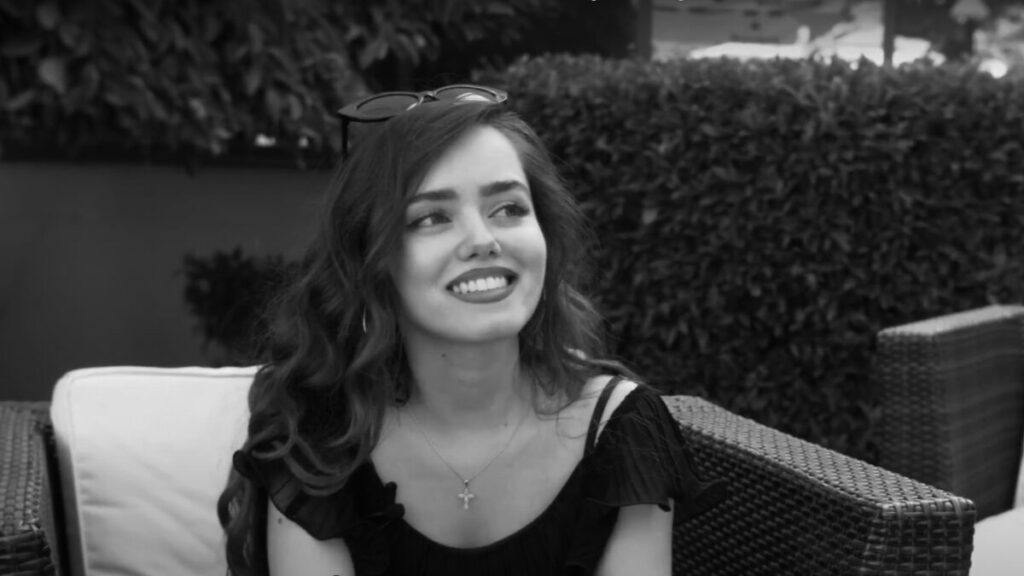
I caught up with Roxana Stroe, winner of this year’s Student Inspiration Prize, to dive into the three bold and brilliant films she brought to the festival. Hello, I’m David Bowie, Poisonous and Paradise Blue each reveal new depths of her talent, and hearing her talk through their creation was a standout moment for me. The conversation had a lot of heart and, in her words, allowed her to relive the experience of creating these films, making this interview one I am incredibly proud to share.
To start off, I’m curious to know where your passion for film began?
I’ve always loved watching films. But as a kid, I never thought of it as something I could do as a career. My earliest memories are of renting VHS tapes from the local store. Every weekend, to escape the pressure of school, I’d treat myself to a new tape. It was my little ritual.
Then came a turning point. I was 11 years old, in 2002, when I went to the cinema for the very first time to see The Lord of the Rings: The Fellowship of the Ring. What struck me most wasn’t the story itself, but the atmosphere, the darkness of the theatre, the collective energy of everyone watching the same film together. That experience was unlike anything I had felt before.
Up until then, film was something I loved, but didn’t imagine pursuing. But by the time I was 17, when everyone in high school was deciding on universities, I realised I didn’t want to study finance or follow a conventional path. Instead, I turned to art, theatre, and film. It was a sudden shift, but one that felt true. Looking back, it was the decision that shaped my life, and I’m grateful I followed it.
The voiceover throughout Paradise Blue is thought-provoking and emotionally intense at times. Can you tell us more about this audio? I’m curious to know how you found those excerpts from 1959, and what compelled you to utilise them in this way.
Paradise Blue was made after the pandemic, in 2022. But its roots go back to that difficult period. During the lockdowns, I was struggling quite a lot. I wouldn’t say I was fully depressed, but I felt very low and creatively blocked. Before that, I had enjoyed a lot of success with my graduation film, which travelled to many festivals. Then I entered a long and frustrating process of trying to develop my next project. And when the pandemic hit, everything stopped. I wasn’t creating, and I felt stuck.
In that time, I began researching depression. Partly out of personal curiosity, partly as a way of processing how I was feeling. I came across a lot of archival documentaries and footage. And that’s when I found this black-and-white material from 1959, where patients were speaking about their experiences of depression. There was something about it that struck me immediately. Even though it was just talking heads, it felt cinematic. The vulnerability of their words, the texture of the images, the aura of that era. It stayed with me.
Where was Paradise Blue shot, and why there?
The images were filmed during a family holiday in Bulgaria, after the pandemic. I didn’t set out to make a film, I was simply shooting because I felt this creative thirst. I wanted to collect images, to fill myself up again after such a long time of being unable to work.
It was a very simple holiday, the kind where you mostly just go to the beach. But what struck me was the atmosphere. People coming together again after years of isolation, rediscovering joy, enjoying life. The resort was full of families with children, and I found myself quietly observing, capturing small moments, little tableaus.
At the time, it was more about memory than cinema. I wasn’t filming with the archival voices in mind at all. But when I got home and looked back at the footage, I realised there was something there. Pairing it with the audio gave it a new dimension. That’s how Paradise Blue came together, almost as an experiment. I never expected much from it, but I’m glad the film has found its way to audiences. And that those voices can resonate in a new context.
How did you approach aligning certain shots with specific lines? Were any of those decisions made in the editing room or was it all scrupulously planned beforehand?
Nothing about Paradise Blue was planned. It was purely observational. I was simply walking around during my holiday, capturing what I saw. Sometimes it was on the street, sometimes on a boat trip, or on the Ferris wheel. Because I grew up at the seaside, in a town similar to the resort where I was filming, these moments also carried a very personal resonance. It felt like coming full circle, reliving fragments of my own childhood as I recorded the present.
When I got back and watched the footage, I realised it needed something more than just the original sound. I wanted to translate that feeling of nostalgia I carried with me while filming. That’s when I remembered the archival voices about depression. Bringing them together felt organic, even inevitable. The contrast between the children’s joy and the voices speaking of struggle created the emotional tone I was searching for.
The aligning itself became a kind of playground in the edit. Because I hadn’t shot the material with anything in mind. I had total freedom to experiment, letting the images speak to me and suggest connections with certain lines of audio. It wasn’t about illustrating what was said, it was about creating a dialogue between the voices and the images.
For me, it raised questions about how we, as adults, struggle. Not always with depression, but with stress, anxiety, and other pressures of life. Sometimes I imagined: what if we could go back to those carefree moments of childhood? Would we experience them differently, knowing what was to come? I don’t have an answer, but that tension between innocence and awareness is what guided me.
We see that Paradise Blue was shot on iphone – what made you decide to go down that route and how do you think it influenced the final look of the film?
I think that happened, precisely because I didn’t set out to make a film, and I was simply capturing memories. I was on holiday, and the only thing I had was my phone, so that’s what I used. At first, when I looked back at the footage, I even thought: I wish I had shot this on Super 8mm film.
But in a way, it makes sense that Paradise Blue was recorded on an iPhone. It carries that spontaneity: you pull out your phone, you capture something in the moment, without overthinking. That quality of immediacy became part of the film’s DNA.
Looking at it now, I actually think the iPhone gave it an extra layer. It adds to the observational nature of the piece, but also creates an interesting tension. You have this everyday digital tool being used to frame images of nostalgia, childhood, and memory, and then you pair it with archival voices from the 1950s. Mixing those mediums, the present, the past, the personal, the historical, gave the film a postmodern texture I really enjoy.
What was the casting process like to find your David Bowie impersonator? What was it that stood out to you about Edward Hayter to secure him such a charismatic and eccentric role?
Casting the Bowie impersonator was both exciting and daunting. I knew it couldn’t just be someone who looked vaguely like him. The role required a presence, a certain charisma, and a willingness to embrace Bowie’s eccentricity without turning it into parody.
When Edward Hayter auditioned, it was clear very quickly that he had that rare combination. He didn’t just imitate Bowie, he understood how to channel an essence, a spirit. He brought his own vulnerability and playfulness into the role, which gave it depth beyond impersonation.
What struck me most was his balance: he could be magnetic and larger-than-life, but also very grounded and human. That duality is what makes Bowie so fascinating, and Edward managed to capture that in a way that felt authentic. He stood out not because he tried to become Bowie completely, but because he was able to reinterpret him with his own energy. That’s what secured him the part.
Does your film reflect a personal attachment to David Bowie and his music? I felt Christian was fulfilling a childhood dream by spending time with Bowie, so I wondered if you shared a similar fantasy.
The screenplay for Hello, I’m David Bowie was written by Joe Wills as part of a school workshop. Joe is a huge Bowie fan, and I think the film came from his own childhood dream of spending a day with his idol. That was the spark for the story. I chose to direct it not only because I admire Bowie’s music and persona, but also because I saw real comic potential in the premise. It was a playful project, and we leaned into that spirit.
I remember talking with Katie Ellwood, our composer, about how to approach the music. Since we couldn’t get the rights to an actual Bowie song, we decided to create one in his style. Recording it before the shoot was such a fun experience, we kept laughing because neither Christian, wonderfully portrayed by Ross Carswell, nor Ed, our Bowie impersonator, had much singing experience. But that made it even better, and it gave the film a warmth and humour that matched its spirit.
I noticed that you worked with a writer on Hello, I’m David Bowie but wrote Poisonous yourself, as well as directing it. Does your approach to directing differ at all when it’s a screenplay you’ve written? Or do you tackle the writing and directing separately?
I do enjoy writing my own stories, but if I come across a script with strong characters that I resonate with, I enjoy directing that just as much. Sometimes I also work with co-writers. It really depends on the story and how it comes to me, there’s no strict rule.
If it’s something I feel very personally connected to, then I’ll often write it myself. Because I already have a structure or direction in mind, and it can be harder to translate that through someone else. But at the same time, there are so many talented writers, especially here in the UK.
During my time at NFTS, I had the chance to read and collaborate on some incredible scripts, and that was a great process. Even if I’m not the writer, I like to be involved in the development, thinking about how we can move from draft to draft, how we can make it stronger.
In a way, I don’t treat the two approaches differently. At the end of the day, it’s always about the story and how to bring it to the screen. With Hello, I’m David Bowie, for example, Joe already had the idea, and it was a short piece, so after just a couple of drafts we locked the script and went straight into production. But when we collaborated again later, it was a longer process, and we spent more time experimenting with character and setup. Both ways are challenging and fun, and I enjoy them just as much.
You noted that Hello, I’m David Bowie was created as part of an NFTS workshop in which you were given 20 minutes of film stock and 2 days to film. What was this experience like? A fun challenge or an extremely stressful shoot? It was clearly a very successful shoot!
Yes, Hello, I’m David Bowie was made as part of a two-day workshop at NFTS, with a budget of just £45 and 20 minutes of 16mm film stock. Luckily, as students we had access to the school’s technical equipment and crew, so all of that money went on the Bowie costume and wig. It was definitely challenging, but I’ve always felt that limitations can actually spark creativity, and in this case they worked to our advantage.
Probably the hardest part wasn’t the two-day shoot itself, but actually finding the right locations. Without a location manager or a budget, it was tricky. We wanted the look of a working men’s club, but renting one was far too expensive. In the end, we managed to secure local spots in Beaconsfield. The karaoke scenes were filmed at The Swan pub, and the breakup scene at Browns restaurant. We were very lucky they agreed to let us shoot, given that we were a student crew with no money, just a lot of equipment moving in and out. It wasn’t easy for them, and I’m grateful they trusted us.
The unpredictability of that process was stressful, but it also made the shoot more dynamic. For example, the bathroom scene wasn’t in the original script, it was meant to take place at the bar. But just a couple of days before filming, I discussed it with my cinematographer, Ndrika Anyika, and we decided to shift it. That simple change gave the scene much more impact.
So while the constraints were real, they forced us to be inventive. In the end, I’d say it was both a challenge and a lot of fun, and I think the film is stronger because of those conditions.
Poisonous was also made as part of an NFTS workshop, but this time in collaboration with a DoP and Production Designer. What was it like to build the set on one day and shoot the next? Did this workshop allow much time for preparation and creative planning, or was it go go go?
Poisonous was made as part of the “3D” workshop: Director, Designer, DOP. I was lucky to work with two very talented colleagues: Cal Ola Hagen as Director of Photography, and Terézia Torousová as Production Designer. The format was simple but intense: at the start of the week, each director drew a word from a hat, and mine was ‘Poisonous’. From there, we had only a few days to come up with an idea, write a script, and prepare a set build for Thursday, before shooting everything on Friday.
In reality, it was even tighter, because by Tuesday we were already discussing floor plans and props with Terézia, so I had to start shaping the story very quickly. That night, after finding out who my two actors would be, I wrote the script. I imagined Poisonous as the toxic aftermath of a breakup, a relationship that has ended but still lingers. The actresses, Cilla Silvia and Katharina Sellner, brought such depth to it. I was also inspired by Chantal Akerman’s Je, Tu, Il, Elle, which explores similar dynamics in an intimate, almost observational way.
So yes, it was definitely “go, go, go.” But I think that urgency, combined with the creative hub the school provided, really pushed us forward. Having such gifted collaborators meant the process moved quickly, and the limitations gave us focus. What began as an exercise ended up as a short we’re proud of. Poisonous premiered on Girls in Film and is now showing at Femme Filmmakers Festival, which feels very rewarding for something that started as a workshop exercise.
Tying in with the last question, were there any specific visual influences on the set design and cinematography in Poisonous? The colour palette ties in beautifully with the slightly dated furniture and wallpaper – I assume there was a lot of mood board making and Pinterest scrolling!
When I think of the word “poison,” I immediately associate it with the color green. It’s a paradox, because green can also symbolise life and growth, But depending on the shade, it can turn into something unhealthy, almost witch-like. Maybe that comes from the cartoons I grew up watching, but I always imagine a kind of “filthy green” when I think of poison. That became the starting point for Poisonous.
Of course, there was a lot of Pinterest scrolling and mood board-making to shape the look of the set. We chose the floral wallpaper, for example, as something that felt alive at first but gradually degraded. Just like the relationship at the centre of the story. The furniture also disappears throughout the film, until at the end it’s just her and the mattress. The space itself becomes a metaphor for her internal state. She has to strip everything away in order to heal, almost like cleansing poison from the body.
Visually, it was a very collaborative process. Terézia, our production designer, and Cal, our DOP, both brought fantastic ideas. Cal in particular worked with green and red light, blending them to create a kind of toxic atmosphere that matched the emotional journey of the character. So while the design started with a single word, the way it unfolded on screen was the result of all of us building that world together.
The shorter films include elements of whimsy and surrealism; were there any films in particular that influenced these recurring aspects?
I think most of my work carries a recurring theme that some might call surrealism. Though I tend to see it more as a kind of heightened realism, or what some describe as emotional realism. It’s realism shaped by the internal state of the characters, so it becomes a subjective way of showing their world. That fine edge between something grounded and something slightly heightened is what I’m most drawn to.
For me, this reflects how we experience life. When we remember or describe moments, we rarely do it in a purely objective way. We use metaphors, exaggerations, figures of speech to convey what it felt like. Cinema gives us a unique opportunity to do the same. To bend light, framing, sound, or gesture in ways that evoke emotions more powerfully than literal representation ever could.
In that sense, I’m very inspired by filmmakers like Robert Bresson. I remember an interview where he said he would rather people feel his films before they understand them. That idea resonates deeply with me. It’s also what I hope to capture in my own work: a cinema that first moves you emotionally, even before you can rationalise it.
Was there much rehearsal for the body-centred storytelling in Poisonous? Was it meticulously choreographed or left to the performer to feel out the movements?
Because of the nature of the workshop, we didn’t have much time for rehearsal. Everything happened within a single week. So I only met the two actresses, Cilla Silvia and Katharina Sellner, over Zoom a day or two before the shoot. I sent them the script, and in that call we discussed the story, their characters, and where they were in the relationship. It was as much about giving them context as it was about me finding out what they would feel comfortable exploring once we were on set.
Normally, with such a physical and body-centred piece, you’d expect more time to rehearse. But I was lucky to work with two very open and generous performers. They embraced their characters fully and gave themselves to the process. Cilla, who played the lead, had the most physically demanding part, crawling on the floor, embodying this fragility and vulnerability. We didn’t have a choreographer, so the movements emerged from our conversations and her instincts.
As a director, I could guide her through the emotional context, but I didn’t want to dictate how she should feel physically. That had to come from within. Cilla brought a beautiful combination of grace and fragility to the role, and I’m grateful she trusted the process enough to fully inhabit those movements.
In the past few years, have you noticed a shift in how female-driven stories are being received in UK and international indie film circuits?
If you look at films like Molly Manning Walker’s How to Have Sex or Charlotte Wells’ Aftersun, even though the father–daughter relationship is central in Aftersun, we experience it so much through the girl’s perspective, you can see how strong female-driven stories are making a powerful comeback. And it’s not only in the UK. Internationally, too, there’s a growing appetite for these voices.
One film that comes to mind is Corsage by Austrian director Marie Kreutzer, starring Vicky Krieps as Empress Elisabeth of Austria. And there are many more. It’s very encouraging to see not just female-led narratives on screen, but also more women-led production companies and initiatives shaping the industry itself.
As a female director, I find this incredibly positive and inspiring. I’m currently developing a feature about a 16-year-old girl growing up in a conservative religious community. And the research has made me reflect a lot on the female gaze, how essential it is, and how powerful it can be in reshaping the stories we tell.
What were the key themes you were aiming to explore within these films? And what message would you like viewers to take away with them after watching?
I see stories as something that reflect where we are in life at a given moment, our state of mind, our moods, the questions we’re preoccupied with. So even though these three films aren’t directly connected, they do reflect different aspects of what I was drawn to at the time of making them.
Two of them, Hello, I’m David Bowie and Poisonous, deal with relationships. One shows a man on the verge of breaking up and starting again. The other looks at the toxic aftermath of a breakup and a woman’s process of healing. In Paradise Blue, I explored depression, but the film closes with images of children and childhood, which to me suggests resilience and the possibility of renewal. If there’s a thread between them, it’s that even in moments of hardship, there is still light.
Pain, depression, heartbreak, these are part of life, but they don’t define us completely. Healing is also part of life. What I hope viewers take away is a reminder that beyond those darker, difficult times there are always moments, sometimes very small ones, that can bring us back to ourselves, to meaning and joy.
And, finally, what is next for you? Tell us about any upcoming projects, where you hope your passion will take you next, and what you’re most looking forward to in the future. We can’t wait to see what you do next!
I feel I’m at a point where moving into features is the natural next step. My debut feature, Houses Are Silent, has just been selected for the San Sebastian Co-Production Forum, so I was there this September. The film is set in a Mennonite colony in Bolivia. And while it’s still very early days, I’m excited to begin the journey of developing it. I know it will be a long process, but I’m hopeful we’ll find the right partners and funding to make it happen.
Alongside that, I’m also developing another short. It’s an adaptation of a story by a Polish writer, for which we’ve secured the rights. It’s a chamber piece centred on a grandmother–granddaughter relationship. Even though it’s based on someone else’s work, it feels very personal to me, because I had a very close bond with my own grandmother. So right now, I’m focusing on stories that feel meaningful, both personally and universally. My hope is to shape them in a way that allows audiences to connect with them too.
I’m also very excited to have shared these three films with the Femme Filmmakers Festival audience. It means a lot to me that they’ve been selected, and that I’ve had the chance to reflect a little on the process behind them in this interview. I’m beyond grateful for the opportunity, and I hope the films resonated with those watching. Until we meet again, hopefully with the two new shorts I’ve recently finished, I’ll keep dreaming, keep writing, and keep celebrating the way cinema connects us across distances.