


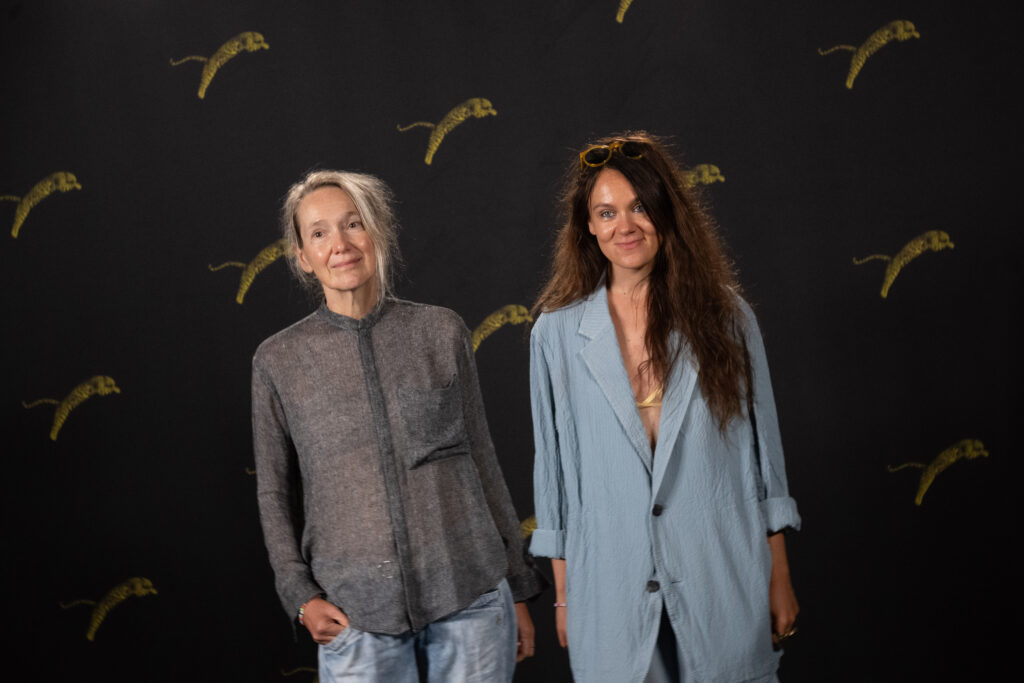
After the world premiere of I Rarely Wake Up Dreaming as part of the Locarno Film Festival’s Concorse Internazionale on Friday August 7, 2026, Hailey Passmore sat down with director Isabelle Stever and writer Anna Melikova to discuss their latest film and second collaboration.
Olya (Tania Myronyshena) and Oleh (Markus Bright) are a young queer Ukrainian couple. As one partner begins his transition, Russia’s full-scale invasion begins. Amidst the war and their changes, the boundaries of masculinity and femininity are challenged. Their relationship is put to the test as they struggle to preserve their long connected bond. While Olya struggles, Oleh must discover what it means to be a man in a country that requires sacrifice to keep its identity and survive the oncoming terrors. A story about love, perseverance, hope and self discovery, in one of the most darkest times the world has ever seen.
*Please note that filler words (i.e. um, yeah, etc.) have been removed for a more simple read through the interview with Isabelle and Anna.
Hailey Passmore: As your film is about a queer couple and their experience as the war breaks out. What made you want to, how did you specifically focus on them and not — because I think there’s lots of films that take place in war, and usually [war] takes over — but you allowed the film to focus more on their journey than letting the war take over.
Anna Melikova: It’s because how it started this project. The story is based on real experience of my friends. So it’s [a] queer couple, and I wanted to write about them before full scale invasion started. I wanted to focus on their private story. How gender transition of one of [the] partners impacts the relationship. I thought it could be, on the one hand, a very unique story with their very special conflict, but on the other hand, I thought that probably many people could identify themselves in some aspects. Because many of us who are in long term relationship, we know that each of us change. It could be changes in appearance or in character and in behaviour. And sometimes it’s not so easy to accept it immediately. That’s why I thought this story has both sides, you know, something unique and something to relate to for many people.
But then, full-scale invasion started. And, it brought a political and social level and a historical. And then I started to write a script, of course, not immediately, because we were busy with coping with this reality and also helping our friends and one of them, it was this couple, queer couple, we also were trying to help them. But we have a lot of friends in Ukraine and some of them left Ukraine, some stayed. After Kyiv region was liberated from Russia occupation. It was April 2022. And I understood, okay, my friends from this region, they are saved but not safe. You can’t stay safe in Ukraine, but they are alive. Then I understood now I can do something to cope with this reality. To cope with my anger. Anger and helplessness. Then I started to write a script, and then I understood, the script will combine these two topics: gender transition and the war — because reality combined.
Hailey: When you were making the script, because not only does, [Olya] says, not that he didn’t ask if she was ready for the change, but there’s also the conflict in war, [it] brings up conflict in people. As you said, the political and all that stuff. Do you think, not that it helps, but how did you keep the difference between reality and the fictionalized version while bringing in that conflict between characters, not just their relationship, but between the parents as well, because you could feel that within it as well.
Anna: I enriched, of course, it’s based on the story of this couple, my friends, but I enriched this story with many, many, many details, which I took from experience of my other friends. Who also experienced the full-scale invasion. And this fictionalization, it was not coming out of my head. I didn’t invent something, but I collect from reality.
Hailey: Did you want to make sure that even though you were telling your friend’s story, because it’s such a personal story, from both of your perspectives. But still make it so it was its own story on its own. If that makes sense? Were they comfortable with it? As well as making it its own thing to make, to allow everyone else [the audience] to relate to it?
Anna: So for us, it was very important to protect their privacy. That’s why people who know this couple but don’t know that one of them is [a] transperson, these people will not recognize them. They knew, of course, that I write the script. So I spoke with them a lot and I recorded our conversations and they were very supportive. They also read the script, different versions of [the] script and helped us with the reality check. So they were very helpful.
Isabelle Stever: As well as the conflict and the desires and the fears of our protagonists are very universal. So people can identify with it. No matter if they are queer or not. Our film is trying to reach a big audience because it’s trying to say something to a big audience, which we think is important, and we worked on a film which is, in a way, not in a niche. The fears, hopes, desires, and conflict of our protagonists, they are universal.
Hailey: While you worked together on script and making it universal. What was it like? Because it’s your second collaboration. So how was this collaboration different from your first one?
Isabelle: It was very different.
Anna: Before we made film together, Grand Jeté, and I wrote the script, but it was adaptation of a novel. And this time it’s adaptation of reality, I would say. It was first time for me that I wrote uh, the script from the first idea. It was my idea, and then I wrote. Then for me, it was very important that Isabelle should be director of this film. There are a lot of reasons why I wanted Isabelle [to] direct, because we understand very good each other, but we also have very sometimes different perspectives, and but they are not like a struggle, these different perspectives, but they enrich each other. I also didn’t want to write the script and to give it to some director and to say “tschuss”, okay, and then to see the film on the premiere. I wanted to stay to be part of the film on each level, on each stage. But Isabelle also was involved in script. So some dramaturgical ideas came from Isabelle, and I was also involved in directing.
Isabelle: *Explains* Mise-en-scène.
Anna: I translated everything for Isabelle, and sometimes it was not so easy for us. But we… Yeah.
Isabelle: We worked very closely on this project together because I’m a German director who has been several times in Ukraine before full-scale invasion started. But of course, I don’t understand the language, and I have not the feeling for the nuances of the culture. And so that was, in a way, an obstacle, but it was also the space in which I thought I couldn’t just direct this film. That’s why I created a space for the others to enrich the film. And Anna was translating the whole time.
The realization phase started in May 2024. Then we did the casting and pre-production until December 2025. We went about three months altogether, of filming in Ukraine, and during the whole realization onset of the film and during the casting and rehearsal project time, she was translating. So we were very close, and we lived together in a hotel, in one room, and we had each night air raid.
Anna: So it was not so easy.
Isabelle: And we are married, and it is a miracle that we are still together.
Anna: Yeah.
Isabelle: And we really worked on it, and it was pretty tough. You can congratulate [us].
Hailey: Yeah, congratulations. Yeah. Well, especially of the conflict in the film, you have that. Speaking of the difficulties when filming, because it’s such a, not a difficult topic, but it’s not an approved topic, even anywhere. Transitioning is difficult and we’re going backwards and stuff. Was it difficult to be able to shoot, like to film the film? In Ukraine and in Germany, in anywhere? Was that aspect of filming difficult?
Anna: At first, we didn’t know if we could film there. They don’t use the word ‘shoot’ anymore because of this war connotation. That’s why we say, “to film”. First we thought maybe it could be one or two days in Ukraine. The rest should be filmed in Germany. But when we came first time to film in Kyiv, we understood we have to film as much as possible there. Of course, it was not so easy to organize…
Isabelle: For the reason, for the authenticity. As well as the head departments, they all Ukrainian. The set designer is German (but) has a Ukrainian partner. Of course, on the original locations, they are more inspired, then if we’ve rebuilt them in Germany. But as well for the actors, the non-professional actors, they can give more authenticity of their personality if we film it on the exact location. But as well as there was this approach of the German producers, they wanted to support Ukrainian film community because there are not so many fiction films filmed there.
Anna: But yeah, to have one example how not easy it was, we had a border scene. You saw the film. We had 110 extras…
Isabelle: 80 cars. 10 animals.
Anna: Yeah, and the crew members. Of course, you have to think what should you do if Russia attacks this part of Ukraine, during filming process. That’s why you have to think how to evacuate all these people. We [had] this situation. It was almost the end of our filming day, and we wanted to film animals. And then it was air alarm that we have ballistic rocket in our direction. But, hopefully, it was…
Isabelle: The system which shoots away the coming rockets.
Hailey: Oh, yeah. defence?
Isabelle: Yeah, defence.
Anna: Yeah, yeah. So it was then, okay, and then we could continue, and then it was like 10 minutes for this animals, and it’s great that we have the faces of these animals in the film.
Isabelle: As well as a location has to be near a shelter. So, if you pick a location, sometimes you want another location which is not near a shelter. So it’s an obstacle for locations scouting, as well as the curfew. Everybody has to be home at midnight. 12 o’clock you have to stay at home until 5 o’clock. You can only leave your home at 5 o’clock. So that’s a very big challenge for the filming.
Hailey: I just have one last question. Because in the film, Olya wakes up at one point and she said she — was this added in after? Because she wakes up and she says she has a dream of an oncoming, and that’s the start. Would you say that that ties into your title and what brought on the title, why is it important?
Anna: I can say something about dreams. I think the dreams they were already in the first draft of the script. They were important for me it’s auto-biographical, because my dreams, and they are chronologically, they were exactly at the same time. So, first dream, I had, before full-scale invasion started. It was this feeling that something horrible will happen 2022. Then full-scale invasion started. The second dream I had in May 2022, it was talked about so intensively that Russia could use an atom bomb weapon. Then I had this feeling that the whole world can disappear. It was important to give Olya my dreams because I needed to give her something personal. And for us, it’s like a visualization of fear.
Isabelle: The dreams are space for Olya’s fear in the film. I invented the title, and it survived. I had a lot of titles and this one survived. I really like it, and there are many ideas how you can understand it. It’s a poetic title. For example, it can work describing the feeling that you’re in a nightmare.
If this happens in a life that war breaks out the reality you are in switches, and you can’t, I think you can’t relate the reality to what was before. It’s just too hard to make this step. So it’s like, “am I dreaming? Is this a nightmare?”
Hailey: It was, yeah, it was beautiful. Thank you. And I really hope it can get to the world so everyone else can see it. Because it’s — even for me, from the Western side — it is so relatable. The conflict. The film’s relatable. I hope that when people can see it, relate to it, and just also see what’s going on from a different perspective.
Anna: Thank you so much.
Isabelle: Thank you.
Isabelle and Anna’s film touches upon a conflict we can all relate to within ourselves. While putting a queer couple in the context of the Ukrainian war, they not only study what it means to love someone else, but share a new perspective of what is going on in the East.