


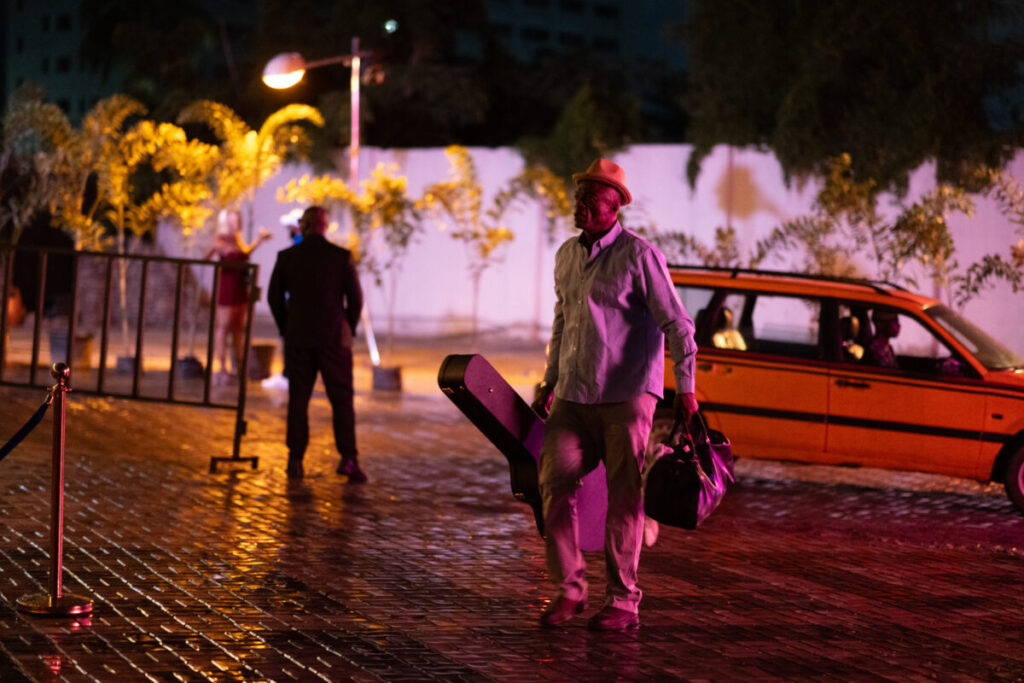
After its world premiere at the 50th Toronto International Film Festival and ahead of its UK premiere only weeks later at BFI’s London Film Festival, Nigerian producer took the time to discuss her and Idris Elba’s new short film Dust to Dreams.
Dust to Dreams is a Nigerian based short film directed and written by Idris Elba from a draft created by Nigerian philanthropist and producer Mo Abudu. It follows a mother and daughter through a difficult time in their lives and a father coming back after years being away. The film, at its heart, allows audiences around the world to connect with its deep roots in family love.
This interview with Mo Abudu was conducted by Hailey Passmore over Zoom. As Mo appeared only through audio, it has been transcribed below (with minor edits removing filler words).
Hailey: What was the collaboration process with Idris like? Who got who involved? Did he come to you? Did you go to him?
Mo: Well, Idris and I met a few years ago. We were both committed to the fact that it is very important to tell African stories. And I think from that point on, we stayed in touch. So, when I did the first draft of the script, I shared it with him and he loved it and he said could he tinker with it and rewrite it and I said I had no problem with that at all. He did a rewrite and he shared the second draft with me and I was happy with the second draft. I was [then] like, let’s make this happen. We were able to get funding for the film from a large African bank, so they funded the film. I originally wanted Idris at that point to be Johnson, the singing soldier, and Idris agreed and then all of a sudden he turned around and said I think I’ve got someone else that I think can play this role a lot better than I can and I’m like oh my god I really wanted Idris to be Johnson and he said I can get us Seal. Then he delivered Seal to us. Five time grammy award winner. That was the beginning of the journey of this becoming a reality. Then together him and I were able to cast the rest of the film with the awesome talent. Have you seen the film?
Hailey: Yes I watched it last week.
Mo: Okay so you can see that it’s such a powerful story. A powerful film with really great actors. For us it was important to tell a story that’s relatable. Relatable to people around the world. Because often, what you find in African film is that the rest of the world sometimes have a challenge connecting. And we wanted this to be a story that anyone could watch and connect to. It’s about family dynamics, it’s about legacy. It’s about a woman who has a daughter who she loves dearly, who had never met her father. This is a global phenomena, so we wanted that to be relatable. And we’re glad that the story has resonated with many people around the world. So, going back to the question you asked, we got Idris to get Seal involved. then Idris and I were together able to cast the rest of the film. Then we decided on our crew. My head producer in Nigeria, Heidi, found all the awesome locations you see in the film. The biggest challenge was finding time in everybody’s diary to go to Lagos and shoot the film. We made a film that we hope and pray that the world is going to love. The response so far has been outstanding. And TIFF was very good for us, in that the feedback and the interviews were able to give just told us that we are on the right path on telling an African story that would have global relevance.
Hailey: You are very right. No matter which character you’re focusing on, there’s a way for someone around the world to connect with them. I think that’s very powerful.
Mo: It’s very important because stories that come out of Africa tend to be what I call poverty porn a lot of the times. If it’s not trauma or some famine or some disease ridden village, that’s what is expected. But what we’ve given in this story is something very different. We were very intentional about creating a story like we have created.
Hailey: That’s lovely thank you. You actually answered one of my questions which was were you part of the casting process. Did you bring someone in to help or was it just you and Idris who did the casting?
Mo: It was myself and Idris mainly who did the casting. He of course did the casting for Seal and the young lady who plays Bisi the daughter, he also did the casting for her. Now she’s a Nigerian based, up and coming, Afrobeats star who I’d never met her. So when he came across her I was like wow. Idris is quite deep and connected to the music world. So when we came across Constance, this was her first acting role as well. So he found her, we both had a few meetings with her and liked her. The rest of the cast and crew, I’d like to say I suggest who would play who. Of course, Idris made the time with such a busy schedule, to meet with cast and crew. And he made time for all of them, he was on every single call. It was just wonderful that he was able to give that much of himself. So together we were able to jointly agree on the rest of the cast. Our cinematographer was a very important part of the process because how you see the film – in terms of the lighting and the cinematography – was very important to us. We hope that as you watched that that was conveyed.
Hailey: It definitely was.
Hailey: When you first wrote the script, was any of it personal to you? Did you pull it out of your life in any way? Or was it just something that you were able to think of that you just wanted to be relatable?
Mo: I think there’s nothing in the story, because I’m not a performing artist and I do not own a nightclub, and neither did my family. So, in terms of pulling anything out of the story, for me it was family. That is something that we can all relate to and the relationships that we have with our family. I mean I have a daughter, I have a son as well. Showing love and that bond between a mother and a daughter is one that is undeniably beyond the surface the emotion that it carries unmeasurable. What we would do for family and our children is unmeasurable. As a mother I know that god forbid if I put myself in a situation whereby I knew that my days were numbered what would I do? Sometimes, it’s about that juxtaposition about putting yourself in that position and saying what would I do if this was me? I do that a lot when I’m thinking about story ideas. The first film that I did, my very first feature film was called Fifty, and I wrote it on the eve of me literally turning fifty and I imagined myself in various scenarios that were not me but if this was me, how would I deal with it? I think that sometimes is the best way to tell stories in that you’ve got to put yourself in positions that other people are often in so that it’s relatable to them.
Hailey: It is a beautifully crafted story so that comes through.
Mo: Thank you so much. I am so happy Hailey that you were able to relate to it. That was such an important part of the journey for us that people like you, who are not in Africa or African, that you were able to relate to the story. In all the interviews I’ve had today, it’s been the same I was able to relate to the story. This was so important for us.
Hailey: It definitely was. The mother daughter relationship for me was relatable. Like you said the relationships were the whole thing, that anyone could be able to relate to, which was really beautiful to see.
Mo: Absolutely.
Hailey: Just one final question. You’ve talked about it a bit, I feel like you’ve already answered it. From the final product of the film, is there a moment in it that you’re most proud of? Or a moment on set that you’re most proud of? Or in general.
Mo: I’m proud of the performance at the end. You know we shot a BTS film about this film and the feeling in the room when Seal and Constance performed that song on stage it was literally like we were just there in a theatre just watching this performance live because it was so real. There is a single coming out that will release before the end of the year, called Mama, that is about the mother and the daughter. I think that for me was the cumulating moment. Where we saw the mother’s wish become a reality, watching her daughter perform alongside her father. That synergy between the two of them and the beauty in the song, that was the moment for me.
Hailey: That’s beautiful thank you.
Hailey: Thank you for taking the time today and congratulations on the film.
Mo: Thank you so much Hailey. Thank you so much. We look forward to seeing your piece come out when you write it.
Hailey: Thank you. I hope the rest of your interviews go well. Are you headed to London with it?
Mo: Yes we are at the London Film Festival next week and I’ll be there.
Hailey: Well good luck and thank you.
Mo: Thank you Hailey and bye for now.
Dust to Dreams will premiere as part of the London Film Festival’s Roots and Branches short film programme on Wednesday 8 October, 2025 at the BFI.
Hailey’s review for Dust to Dreams can be read on Filmotomy here: Dust to Dreams (Elba, 2025).