


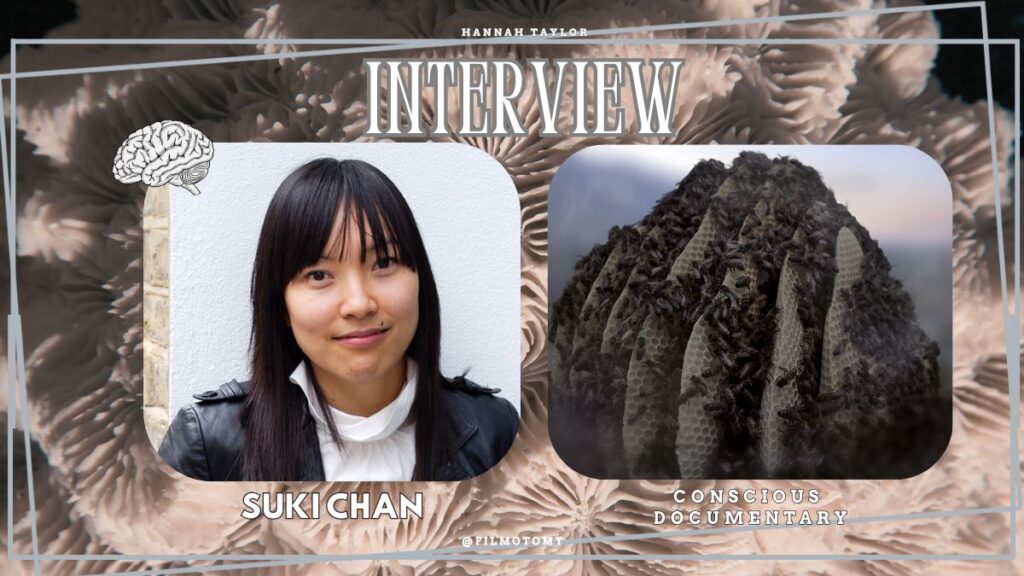
Artist and director Suki Chan discusses the eight-year journey of making her documentary feature film debut, Conscious. At this year’s CPH: DOX (Copenhagen International Documentary Festival), Conscious had its World Premiere. The documentary featured creative collaborators. From Michael Ellis (Superman, 1978) and Chris Parks (The Tree of Life, 2011) to Dominik Scherrer (Ripper Street, 2015), and James D. Fleming (Avatar, 2009).
In this interview, Suki Chan talks us through the process of making Conscious. From the research stages through to finding her protagonists and the legacy they leave behind.
1. Hi Suki, Conscious is your first feature, do you have a personal connection to dementia? And why did you choose the subject matter? Is this subject close to your heart?
When I began this project eight years ago, I didn’t have a personal connection to dementia. As I learned more and more about it over time, two years ago I started to recognise early signs when my mother’s memory began to deteriorate in ways that felt beyond typical ageing. As a result of that awareness, I was able to seek support for her through the health authorities at an early stage in the UK.
2. What were your initial plans going into the project? And how did you shape the narrative between telling both an emotional story with a scientific angle too?
My initial plan was to explore the nature of consciousness, and I approached it from a scientific and literary angle. I was interested in the idea of the bell-shaped curve of consciousness. On how our perception of ourselves and the external world develops in early life and gradually diminishes in later years. William Shakespeare’s Seven Ages of Man was an important reference point. Though I was interested in these phases not as distinct stages, but as continuous and evolving across a lifetime.
During my first pregnancy, I began to reflect on my son’s sensorium. On what he might be experiencing and perceiving – and this led me to imagine a film that included an additional, prenatal stage. At that point, dementia was intended to be just one chapter within a broader exploration.
Given my background in exploring vision and perception from an art and science perspective, the emotional dimension of the film developed much later, as I met my protagonists and their stories began to shape the narrative.


3. In terms of the research stage, how much research went into creating this documentary? And what were the strengths and challenges for shaping such a long-form project?
The research phase began in 2017 and lasted for about six years. It was a substantial and formative part of the project. But even when the script was completed in 2024, I was still researching to some extent. I was trying to clarify and refine what I wanted to say.
In terms of the early stages of research, I undertook an artist residency at a dementia care village, Belong, in the northwest of England. It was there that I met Pegeen O’Sullivan. When I asked her how life felt for her now, she said she was no longer afraid. That response surprised me – it revealed my own fears about dementia. In what is often described as a “dementia century.” I was very afraid of this disease that steals our memories and dismantles the self.
One of the key challenges of such a long-form project was the scope of the subject itself. Consciousness is an enduring enigma that has captivated philosophers, scientists, and artists for centuries. So it was important to find a perspective that felt both intriguing but also accessible.
We first reached out to Anil Seth in 2017 but didn’t meet until 2022. In the intervening years, I spoke with many other scientists. But when Anil and I finally met, there were so many points of references and connections to myself and also the other protagonists. It felt right to continue the dialogue with him.
4. The range of perspectives you delve into are interesting in Conscious. We go inside the minds of each speaker as they narrate their side of the story. They are almost playing like a character in a film. How did you find your subjects for Conscious and what was your main aim to achieve behind the project?
At the start of my research, I reconnected with Colin Blakemore, a scientist I had previously collaborated with. When we met, Wendy Mitchell’s book Somebody I Used to Know was on his table, having been sent to him by Bloomsbury. And it was through this book that I reached out to Wendy. I visited her many times over the years to conduct interviews with her. These became central to the shorts that eventually led to the feature film.
Maureen Winfield was someone I met through Wendy. When I heard about Maureen’s story, I was really drawn to her dilemma. And it made me want to meet her. I’d never heard of a story like that before and didn’t realise that that could happen.
When I found my protagonists, I thought of them as a quartet of voices. Each one would represent a different perspective.
Maureen‘s narrative embodies a struggle; her challenge was about how to reconcile with the man Michael became due to dementia.
Pegeen‘s story represents hope: although she has lost her memories, she has also lost her childhood traumas and fears – and is for the first time comfortable with herself.
Wendy‘s journey symbolises resilience, as she articulates her experience with dementia and develops inventive coping mechanisms, such as photographing her hallucinations to discern their reality.
Anil Seth is our guide, steering us through his scientific journey to unravel the mysteries consciousness and the self, and help us to connect us with people whose reality is at odds with ours.


5. Conscious has been an eight-year journey. What have you learned throughout the process as a filmmaker, both emotionally and physically?
I’ve learned the importance of time and patience. It took eight years to make this film, and although it might have been tempting to try to move faster, I don’t think it could have been done in less time. In a very natural, unforced way, conversations and ideas developed. I took courses to learn new skills, friendships were formed, and trust was built slowly over time. The style and techniques also evolved – always through dialogue and collaboration with the protagonists and mentors.
As the film has narrative elements, we created dramatisations involving the protagonists themselves, rather than actors. That wasn’t something I had initially planned, but it felt right as the project developed. The filmmaking process can be cathartic, if the right foundations of trust and care are in place.
Patience was also essential in listening to my protagonists. As the youngest of five children, I’ve always valued observing and listening to older people, especially my grandmother. In Chinese tradition, the older generation are seen as living treasures, with so much wisdom to offer.
I would spend weeks listening back to my recorded interviews, trying to fully understand my protagonists’ perspectives and make sense of their experiences.
And patience was equally important in the process of making a feature film. It has been challenging and has pushed me to grow in many ways – as a writer, director, and producer -while working with contributors, cast, crew, and funders, and at the same time caring for my own young family and supporting my mother.
You are stretched in many directions, but I’m deeply grateful for this journey, and for the people I’ve met along the way, who have each shown me the depths of their strength in the face of adversity.
6. It must be tough filming such an emotional documentary and with contributors who are sadly no longer here. What do you hope their legacy wrapped up in Conscious leaves behind?
I lost my father when I was quite young, and I’ve always regretted not recording his voice. I’m not even sure I remember it clearly now – I think I do, but it’s hard to know for certain. It’s a great loss not to be able to share his voice with others or ask him the questions I would have loved to. The same was true with my grandmother; when she passed, it felt as if a library had burned down.
In many ways, this has made me cherish any time I have with people, to learn about their perspectives and life experiences. I knew from the start of making Conscious that my time with the contributors would be finite, which made me focus on them fully. I began filming in high quality even during the research and development phase, long before funding was in place.
Creating a Safe Space
We were very careful when planning the dramatisations with Maureen and the actor who would play her late husband. Maureen and her daughter, Jacquie, were consulted throughout the casting process, and we were also supported by Film In Mind. It was important to create a safe space for Maureen’s story to emerge authentically. Sam Dale, who played Michael, was tremendous – he was willing to go to great lengths to convey the essence of Michael. He was incredibly supportive and also in awe of Maureen, who is a natural in front of the camera.
I’m deeply grateful to be able to give something back to the families and friends of my contributors – a lasting record of their experiences. And to offer new audiences a chance to meet protagonists like Wendy, who are no longer with us, while also celebrating those, like Maureen, who continue to share their stories. Together, we’ve created a film that represents their lived experiences for others to learn from. I hope the advocacy work of Wendy Mitchell and Maureen Winfield, as well as the research of Anil continues to resonate and inspire through this film for many years to come.

7. In terms of working with the creative collaborators – Michael Ellis, Chris Parks, Dominik Scherrer, and James D. Fleming and producers, Amara Reques and Teresa Grimes – how did you on board their help and what was the creative process like working with them?
Teresa Grimes was my gallerist and has represented my work as an artist since 2010. She was the first person to read my proposal back in 2017 and has been a steady presence on the project.
Composer Dominik Scherrer and I have been collaborating for sixteen years. We’ve worked together on most of my shorts, and his contribution has always been integral to my work. His music is beautiful and often stays with me. For me, sound isn’t an add‑on – sound is 50% of the experience of a film. Through these years of working together, Dominik has a deep understanding how to score and shape the emotional and psychological beats of my films.
‘Conscious’ – Creative Collaborators
I first worked with James D. Fleming on a short film in 2011, at that time he had already worked on films such as Avatar. I was thrilled to collaborate with him – to bring to life a theory that Anil has helped to popularise – that our brains hallucinate our conscious reality.
Michael Ellis first helped me edit down an earlier short, and through that process it felt very natural to bring him onto the feature. As a child, I was captivated by Superman (starring Christopher Reeve), so it was really special to get to know Michael and collaborate with him on CONSCIOUS— his experience with editing narrative films really helped shape the narrative structure of the film.
I met producer Aimara Reques at CPH: DOX, when I pitched the film in 2022. We were selected to return for the Forum the next year, and it feels wonderful that CONSCIOUS now has its world premiere here too.
I’d been a long admirer of Chris Parks’s work since The Tree of Life (Terrence Malick); his microscopic cloud tank imagery are extraordinary and unprecedented. The way he evokes the origins of time and space resonated with me, and I felt that they could also be powerful visual metaphors for consciousness itself.
Working with this remarkable group of collaborators and producers has been an amazing process. Each person brought their own expertise, and together we found new ways to collaborate creatively in ways that was very much more than the sum of the parts.


8. Would you make a documentary again regarding the similar themes of mind, memory, and illness? And what are your future plans for your next project?
I’m currently thinking about animal consciousness and intelligence.
9. Finally, where can filmmakers and viewers find and follow alongside your journey on social media?
We have a dedicated website for the film: www.theconsciousfilm.com
I have my own artist website: www.sukichan.co.uk
Socials:
Twitter: https://twitter.com/missSukiChan
Instagram: https://www.instagram.com/schansuki/
Facebook: https://www.facebook.com/SukiChanArt
LinkedIn: https://www.linkedin.com/in/suki-chan-6a8272a/
IMDb: https://www.imdb.com/name/nm11526268/
Thank you so much for talking with us, Suki!
You can read our review of Suki Chan’s documentary, Conscious here.
There’s also a new screening at CPH:DOX on Tuesday 24th March 2026.