


Les Yeux Verts follows young Chaya (Douae Butarbuch Mzaouki), age 11, living with her brother, Nour (Sayyid El Alami) and father by the ocean in the Landes region. Immigrants to France, one day they learn they are being evicted. The news causes Nour to fall into a deep and inexplainable sleep. Needing her brother back by her side, Chaya will go to great lengths to wake him up. Even entering his dreams, if it should be so necessary.
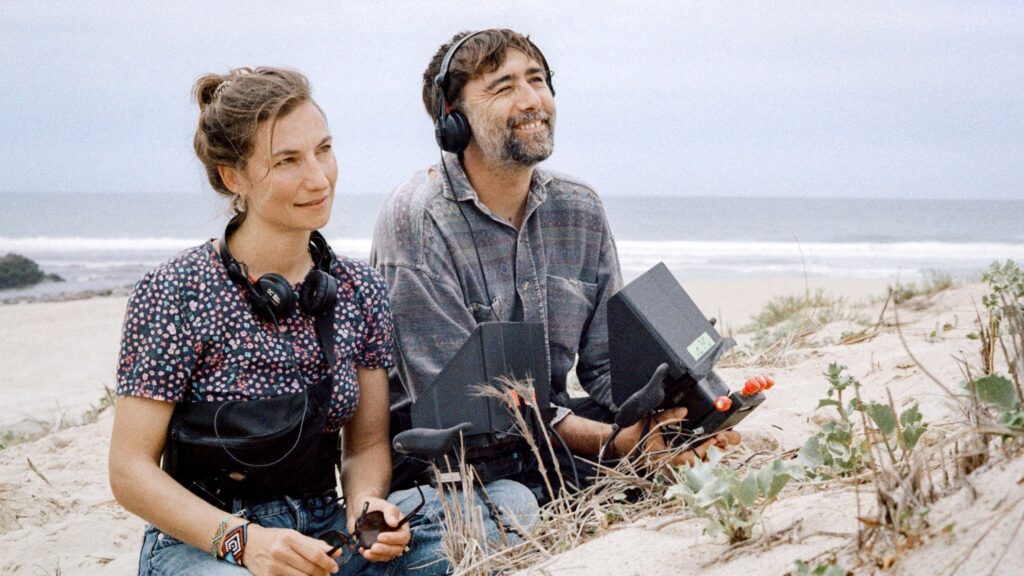
After its world premiere at the Locarno Film Festival at the Piazza Grande on Wednesday August 5, 2026, sitting down with filmmakers (writer-directors) Fanny Liatard and Jérémy Trouilh, we discussed their film and process.
*Please note that filler words (i.e. um, yeah, etc.) have been removed for a more simple read through the interview with Fanny and Jérémy.
Hailey Passmore: So congratulations. It was really beautiful.
Pair: Thank you.
Hailey: Yeah, the visuals were lovely. As it’s about resilience and kind of trauma from a child’s perspective. What made you want to make it a child’s perspective? instead of, ‘Cause adults and children, of course, experience things differently. What do you think the importance of the child’s perspective?
Fanny Liatard: When we discovered the resignation syndrome, of course, it touches children, teenagers, so… and we had this previous desire to make a film with children, because we had worked with some children on Gagarine, our last film, and on short films, and it was a very exciting project for us to experience that.
So when we found out [about] that syndrome, we started to try to imagine what can happen in a child’s mind, to go so deep into… this condition. And so, we found it was interesting to talk about migration in this little example of one family, one child, and so, maybe we think it can be a different way to talk about the migration story. Not different, but many, we hear many, many things about migration, and so, we concentrated ourselves on one child, one little girl.
And then, of course, the question came of what is in her dreams, her imagination. And so, one departure point of this projection was an interview we’ve read, when we were doing researches on the resignation syndrome of a little boy who said he didn’t remember anything, when he fell asleep. But just a feeling that it was as if he was in a glass cage at the middle of the ocean, and that if he would do one movement, the cage would break, and he would be drawn in the ocean. And this image was so strong that it was, I think, maybe the image that finishes our film, and we kept this, and then we had to create all the world between the falling asleep and being in this very radical dream.
Jérémy Trouilh: Good. *Agrees with what Fanny said after I looked over to see if he had anything to add.
Hailey: About the dream world. Would you say that the location you chose to make, to shoot, and I found it, like, really helped, like, make the magic of it, ’cause even though it’s about the resignation syndrome, and about, like, immigrants and stuff, I’ve, there a lot of it, like, if a child watched it, it’d be about the dreaming, and, like, the escape. And even though it’s turns into, like, nightmares, too. Um, what made you want to shoot [in the location] where you shot the film?
Jérémy: Thank you. It makes me think that for Gagarine, our first feature, we used to say that we wanted to make a film in a housing project, but making a step aside, to look at it on a different angle. I feel that locating a migration story in that landscape helps us [make] that step aside, to look at the people who go through that story, on a different angle, from the perspective, [that is] usually being shared, is just stories. For us, making that step aside, feels like giving an opportunity to the viewer, to change his mind a little, or at least to grow his way of feeling.
And, the sister of territories, particularly the land forest, which is one of the biggest in Europe, and which is, unfortunately, burning at this moment, is my home country. I grew up there. Fanny spent many years over there too. So it’s a place we know well. And when we decided to root the story there, we began, like, newly explorers of this place. We knew it, but we didn’t know it so well. So we began working the territory, and finding this lighthouse in the middle of the forest, this little village covered by sand during winter, many elements that refer almost to a fable. So you’re totally right, it helped us a lot to create this magical atmosphere. both in the reality, as a kind of paradise where they have put their luggages and began to build a new home. And in the dreams, using the same landscapes, but transforming unique through sound and the way we shoot it.
Hailey: For sure. As much as it is about the landscape. Would you say that when you, [or] did you find resignation syndrome, and that’s what made you want to tell this perspective of the immigrant story? You said that you wanted to tell it from a different angle. So, was that the angle that you were going for, or did it come to you accidentally?
Jérémy: We didn’t want to do a migration story. The first step was finding out about Resignation Syndrome. Which was, in itself, a step aside about migration stories because it’s at a child’s level. So maybe that’s also what attracted us or impacted us differently.
Hailey: Once you found out about it, how much…Before creating your story, how much research did you do into the syndrome?
Fanny: We usually have the starting point, and we feel free to start to go into fiction. But in parallel, we made a lot of researches, but all the way longer, the writing, what we did, which was very important and inspiring, was to first spend time with children in the same situation. [Those] waiting for asylum with their families, and especially in this territory, in the rural territory. We discovered the issues, the specific issues they face with their family in this type of small villages where they can’t really move because there are no public transport and things like that. And also, we worked with children about their dreams, about sleep, sleep, and questions like that. It was very interesting.
Then there is the theoretical researches and the articles, everything, and very importantly, we had [met] with the Dr. Kranz, who appears in the film. She’s the one [we] interviewed about resignation syndrome, and she’s actually the specialist of this condition, because it’s, she followed hundreds of children victim of the syndrome.
Then one very important part of the work was, you know, the court in France, where you ask asylum for the second time, and it’s really what happens in the first scene of the film, the trial, the CNDA, France, this court of big, big court next to Paris, there is one in France, administration where hundreds of asylum askers are coming every day, facing judges, telling their stories. So we’ve heard many, many stories of migration.
All these elements, of course, and then all the researchers in the territory, about the nature, the cranes, the forests, are some materials we gather to create the realistic part of the film, but also to nourish, nourish, and to feed the dreams part.
Hailey: It fits, it makes sense, and you can see that in the film. Then as much of the research you put into it, it also, I find comes down to the casting. Like, sometimes you can get… I mean, they’re kids, right? But then these two, they had a connection together. How did you find them?
Jérémy: Yeah, well, Chaya, we looked for her for an entire year of casting process that was taken care of by many people, but needed by Judith Chalier. We finally found her Douae [Butarbuch Mzaouki] in Belgium, in Brussels. The first tapes we received from her had this special likeness that we really needed for Chaya’s character because she’s going through a lot, but we always wanted this film to also feel like a story of hope. Chaya gives that hope because she never gives up. So when we met Douae, who had, at the same time, a determination and a joy, also a joy of playing. She had never acted, but when she was, you could see that she liked it, like genuinely, like a kid can like to play soccer or dance. And so that was her.
Then she met Sayyid El Alami, who is grown up, professional actor, and who, of course, understood the importance of creating a link with this little girl who was going to be his little sister. So he spent a lot of time with us in Belgium, with her, with her big sister, with the double. The big sister had this role. She was a key of the possibility of doing this film, because a kid can only shoot, like, 3 or 4 hours a day. So every day the sister would also be part of the process. And it was beautiful, actually, to see those two sisters going through this adventure together.
I think then around Chaya, all the young adults who act in the film, created a special link with her, and it helped both of them each time. Because as Anamaria [Vartolomei] said, the teacher, she began acting when she was 11, and she says that she tries always to remember how it was as a kid to act, because there was something pure that she wants to feel again all the time [when] she does a movie. And so connecting with this little girl, maybe, it also helped her to reconnect to this sense of acting. And on the other situation, of course, she gave a lot of maybe, I don’t know, confidence to Douae, to go through the process of filming.
Hailey: Even though it is, like, it’s a kid’s perspective and everything, I feel like even as an adult, it brought my attention to the resignation syndrome. Do you hope, like, not only your film, but [as well as] other films out there that have these topics that wouldn’t otherwise be heard or seen. Do you hope to see that continue in cinema?
Fanny: Yeah, of course, we made this story, with the hope that we can put faces on these issues of immigration. These stories we heard, sometimes [they] sound very far from us. But we are part of the conditions also. We were saying yesterday, the screening, that we were in the region of Leland, where we shot the film. Two weeks ago, when the fires burned, all the forests, you’ve heard of that. And so, we had very close people who had to live from one minute to another, their house, and everything burned, and they are without nothing in one day, and they’ve lost everything, so it can happen to anyone, and to us.
So, maybe with taking conscience of that, we have to continue these kind of stories to increase empathy towards this situation. So, we hope our film can do a little, little work about that. And also, something a bit maybe naive, but we think that being moved with cinema and is something quite political already, and we try, also, with our films, to bring the public in an adventure, in a dream, because for us, it’s not to show the positive aspects of humanity, [but that] we have to improve.
Hailey: Well, at one point Chaya’s teacher says “make us dream”. I feel like you started with that, and then even though it didn’t stay in that territory, it did come across in the film.
My one last question is, what is the importance of the crane? Or what, to you, is the importance of the crane? Because you have them at the at the start, you bring them back at the end, and throughout as well.
Jérémy: Well, the cranes are in the film because they are in this territory. Every year, on their migration process, they stop in the long swamps, and they stay here during winter. And we went there to see them, and it’s impressive. They are creatures. Tall like that gestures to their height and they fly all together as thousands and thousands of birds, and the way they scream, communicate, it feels almost prehistoric, you know? It gives a sense of universality of the place where we were. So, of course, we had to integrate them in the story, and, of course, when we went into Chaya’s mind, we could easily imagine how fascinated she could be. From her curiosity and also the way she connects with nature.
There is this little girl who did an exposition about cranes, and who got fascinated about them, and who is waiting for their arrival, but they are not coming yet. And it’s a sense of looking up and keeping hope. When they finally arrive, they are beings from maybe her imagination, maybe from mother nature, who will protect her, call for help. [They] become this organic protection around her. So it helped us a lot on the creation of the final act, this comeback of the cranes.
Hailey: Would you say it was a happy coincidence that they were at the location?
Jérémy: Yeah, totally. It’s a gift from the territory, yes.
Hailey: Well, it was beautiful.
Jérémy: Thank you.
Hailey: Thank you for your time.
Grateful to have gotten to talk to writer-director pair Fanny Liatard and Jérémy Trouilh, their film has the possibility to truly be inspiring. Open us up to what is out there. One can only hope that it makes its way to more film festivals.