


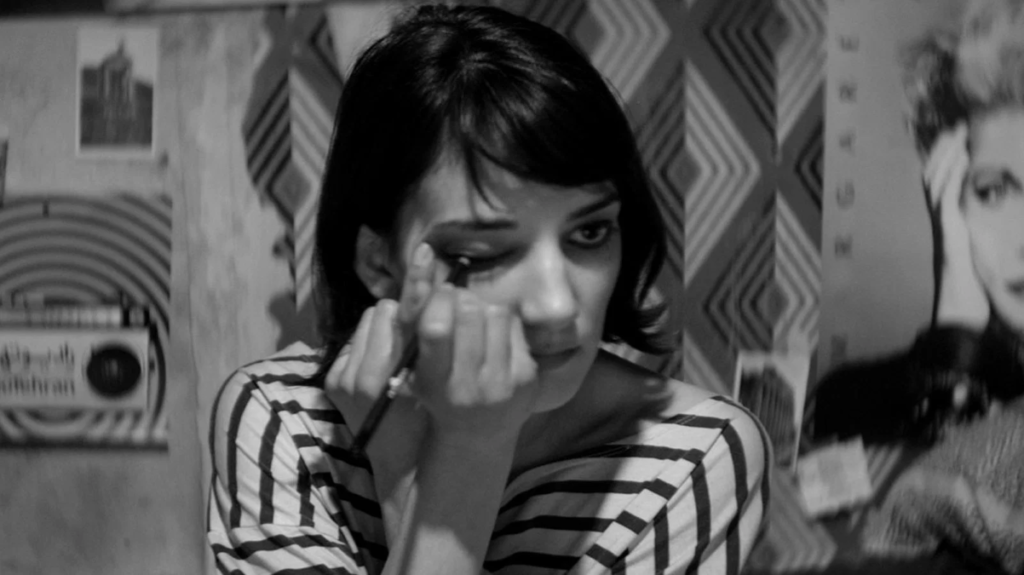
I love this film and that’s kind of the review. A fork was also found in the kitchen, I don’t know if you heard.
Last October, when I watched Only Lovers Left Alive and saw all those gorgeous scenes in Tangie I started selfishly hoping for more vampire films with MENA settings. I think there’s something to say about Gothic literature’s historical construction of supernatural creatures as threats from “the East”. Any vampire lore that moves beyond the familiar Balkan/European framework is especially exciting to me. I’ve always loved the liminal space that vampires occupy geographically. I think stories drawing on Ancient Mesopotamian traditions, Middle Eastern folklore, or the histories and cultures of regions once incorporated into the Ottoman Empire have so much potential.
It was pretty great that I stumbled upon the self-notarised ‘First Iranian Vampire Western’.
A Girl Walks Home Alone at Night is the feature debut of Iranian American director Ana Lili Amirpour. It developed from a short film of the same name, which featured a different lead actress. The short follows a girl in a chador as she walks home alone at night, unaware that a man is stalking her, until she reveals herself to be a vampire. She murders him for his actions.
The feature builds upon this initial concept. It expands it into a rich story that takes place in a fictional town called ‘Bad Town’ (the sets of which were actually filmed in California, not Iran). It is a setting with classic elements of a Western and fittingly the whole film is in black and white.
The film’s script is in Farsi but contrary to belief it is an American film, with Elijah Wood of all people as its executive producer under his production company Spectrevision.
In the fictional Western town of “Bad city” Arash (Arash Marandi) is struggling financially due to his father’s addiction. He unknowingly forms a connection with a nameless manhunting vampire (Sheila Vand). He crosses paths with her in his quest to make ends meet. ‘Girl’, the vampire, is this enigmatic spectre. She is as much a vigilante as she is a deeply tormented predator. She also skateboards. Her plight is picking off violent men. We also see her torment a small boy into not falling into evil by telling him all the horrific ways she will maim him if he is not ‘a good boy’. I think this is where the skateboard appears. I think she stole it from him.
I love all the details. I love that Margaret Atwood is Madonna on the wall of Girl’s bedroom. I love the score and the media references. I really love the intentionality of the director using the elements she wanted and not thinking about the external audience. A lot of the filmic choices feel so organically amazing because they were just taken from Amirpour’s mind. In an interview with Vice she conveyed the importance of being authentic despite how the story ought to present. I think the perfect example of that, and what I believe is this film’s most phenomenal scene, is the White Lies scene.
On paper it sounds utterly insane: we’re going to play the entirety of an indie rock/post-punk song from 2009 and the audience will deliberate whether or not a vampire is going to devour the boy on ecstasy she found on the street enamoured with a street lamp dressed as Dracula. It is instead, wholly amazing.
I’ll admit a lot of these story elements in isolation reek of what was cool in 2014. I promise, when I’m not writing them out plainly they don’t seem this dated. Skateboard, hamburger, The White Lies, intentionally black and white cinema—very nostalgic as a film from the early 2010s.
But what is this film communicating through vampirism? It becomes apparent that, despite her role as a protector, the girl feels neither fulfilled nor celebratory about what she does. She casts many a dejected nod at the fact that she is self-admittedly ‘bad’. Even the film’s title is an interesting subversion. The ‘Girl walking home alone at night’, is a schema of vulnerability. There is no suspicion that the girl is the threat in this scenario.
The film acknowledges the vampire as an artist, an addict, a historian and a murderer. But the girl introduces an impenetrable element because there is little to no exploration of what vulnerability comes from her curse. This vulnerability typically makes vampires relatable or human, the consequential ‘thirst’. Despite this, we still recognise her humanity in her sense of justice. She is also seemingly human in the loneliness expressed by her body language and the hopelessness of her evil surroundings.
This is the last feature I have reviewed and it feels really awesome to end off on a vampire film. Last year I finished my reviews off with Humanist Vampire Seeks Consenting Suicidal Person and it was completely unintentional that I ended on this one.
I really love this film, I almost find myself in a situation where I don’t have much to say.