


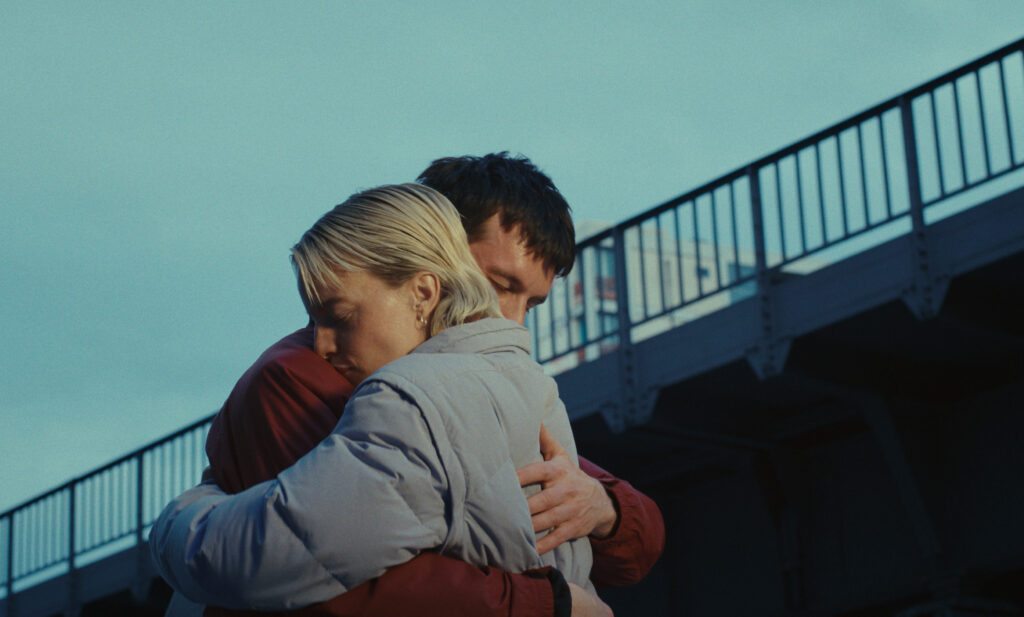
If two people have a strong enough love and bond with each other, can their relationship overcome their individual toxicity? Can they survive long distance on top of that as well? Or, no matter how hard they try, are they doomed from the start? Sometimes people do not recognize their flaws until it is too late. But of course, that is a fact of life. It is what makes us human.
With high aspirations, her second feature-length film would be one to cause an inner panic in its viewer. Writer-director Anna Roller, along with original novelist Leif Randt, adapted his novel into a psychological and stunning piece of cinema, Allegro Pastell. Not only does her film work visually, with the two protagonists the viewer is invited into their lives and prompted to self-reflective thought.
In the summer of 2018, between Berlin and Frankfurt, two are involved in the most ideal and almost flawless long-distance relationship. At 33-years-old Tanja Arnheim (Syl Faligant) is an up-and-coming writer living in Berlin. Then, as a web designer, Jerome Daimler (Jannis Niewöhner) has recently moved into a bungalow in his hometown of Maintal. Visiting each other often either in Berlin or in Jerome’s bungalow, they remain constantly connected through emails they send each other.
In a romantic drama such as Allegro Pastell, there are many meanings the audiences can find within. To give this chance, however, there needs to be the foundation to build on. Within moments, viewers are introduced to Tanja and Jerome in their most intimate setting. It becomes clear from this point on that Roller had all the prior knowledge and passion to produce what was needed for this adaptation. With the understanding of where Tanja and Jerome were headed, Roller took audiences on the same journey with them.
“How much longer until there’s nothing left to say?”
Constantly used to things going their own way, seemingly everything was under control for both Tanja and Jerome. Yet this carefully planned balance of trust through their separation approaches the brink of collapse as Tanja undergoes a realization. On her 34th birthday, Jerome presents her a website he created, the first bump in their relationship occurs. As Tanja wonders if this relationship could become existential, the couple begin to drift apart.
Not everyone may be familiar with the difficulty that comes with long-distance, but it can almost be certain that the daily struggles in a relationship can become relatable. In their performances Faligant and Niewöhner quite evidently have that connection and empathy within them. To understand the inevitable feeling helps the selfish quality of their characters shine through. It is almost polyamorous in a sense, how Tanja and Jerome act.
From the novel to the film, the idea of existentialism comes through almost as much as that of toxicity in individuals. Two characters who are so selfish and yet mix quite well together. Yet it is with this long-distance relationship which they do so. To think of it more and more becomes this idea of fitting into the norm. Do they continue with their current status-quo? Or do they take a new path and become a couple who follow regular relationship etiquette? There is more than one way to look at Allegro Pastell and see the message they wish the audience to receive. It may not be apparent for all, but the universality in it is there.
At times, when couples stay together this can become poisonous to who they are as individuals. Being able to understand what is best for one another can be the best thing to do. To understand the love you have for one another and be able to keep it. There is growth that happens in any situation like this. Allegro Pastell might have been adapted from a novel where in which somethings are not brought from book to screen. But one thing is for sure, that universal and generational story is there for the taking.