


A white blank page, a blinking cursor, the words READ ME. Is any beginning more enticing than this?
A recently bereaved young woman is about to be sucked in, and flung down the rabbit hole by those very words. It’s just one of countless images throughout Lynne Ramsay’s sophomore feature Morvern Callar (2002), which fill the frame with wonder and promise.
We are drawn in by Samantha Morton’s magnetic performance, and the way Ramsay strongly aligns us with her point-of-view. Morton is in every scene, almost every frame. We’re either looking at Morvern, or we’re directed to something that she is focusing on in that moment. From the film’s hypnotic opening sequence, to the its cathartic closing minutes – we are on this journey alongside Morvern – all the way.
Morvern Callar has one of the most evocative and entrancing openings of all time. We begin on a close up of Morton’s face. Being intermittently illuminated by what will shortly be revealed to be flashing Christmas tree lights. She is caressing her lover, who appears to be sleeping beside her.
After the title appears, we abruptly cut to a wide shot of the room (containing the Christmas tree) and it’s immediately apparent that something isn’t right. We can see the that the kitchen floor has a large bloodstain splattered across it. The man is lying face down, with his arms at odd angles. And there is blood around his hands and wrists.
Morvern lies a couple of feet away, facing away from him, at an obtuse angle. The tableau is reminiscent of the start of a modern dance piece. As if both figures will suddenly spring to life and begin to move around one another. But the glowing computer screen, with it’s Lewis Carroll-inspired instruction, contains a suicide note.
It’s a shocking way to open a narrative. But it undeniably makes you want to know more about both of these people. But Ramsay will keep the newly-deceased man frustratingly out-of-reach throughout what follows. We only discover his name when Morvern is actively erasing it from the title page of his novel and replacing it with her own.
When discussing him with her best friend, Lanna (Kathleen McDermott), they will only ever use the pronouns “he/him” – never his given name. He quickly becomes an enigmatic figure, whose absence is a driving force for Morvern throughout. But he only functions in relation to her.
For someone like Morvern, who has very little – no family, not much money – small, seemingly insignificant objects become important to her. The dead man has left Christmas presents for Morvern, fulfilling the needs he thinks she’ll have now that he’s gone.
They will provide her with warmth, light, and music. A black leather jacket, a lighter, and a Walkman with a mixed tape. She plays with the lighter – dancing her fingers across the flame. An indication of the self-destructive tendencies Morvern will display later. The mixtape will prove to be something of a companion for Morvern for the rest of the film. In one of Ramsay’s frequent uses of dark, twisted humour, Morvern takes thirty quid out of the dead man’s pocket, but feels guilty and puts ten back.
Morvern and Lanna go out – to a pub and then a house party. While the drunken revellers dance around a bonfire on a beach, Morvern stands high on a cliff, enshrouded in darkness, utterly alone. A fisherman in a boat shines his torch at the shoreline, illuminating Morvern (as she was lit by the Christmas lights in the opening images). She lifts her dress to reveal stockings and suspenders, and defiantly tilts her head back. Her long neck is starkly white in contrast to her black clothing and the inky black night that surrounds her. Just when you think she might lift the dress further, she pulls it back down.
Morvern stands apart from the crowd and Morvern is in control. She’s about to take her life very much into her own hands and start calling the shots. But after everyone at the party falls asleep, Morvern sits on the floor by a Christmas tree playing her with her new lighter again. Although, this time, tears are silently falling from her face. Grief is going to be ever present, pervading all she is about to do.
When Morvern returns home, her lover’s body is still exactly where it has been since the opening frames of the film. She has not called the emergency services, she’s told no one of his death, and his body still remains where it fell. It exists in the liminal space between the kitchen and living room. And it lingers there during the limbo period between Christmas and New Year. During this week of the year, as well all know, time ceases to exist and a purge-like atmosphere pervades, where nothing really matters.
Morvern covers the dead man with a sheet and reads through his instructions, left on the computer screen. She sees the novel’s title page, and slowly and deliberately deletes his name. Using a chunky early 2000s PC keyboard. And types her own name in its place. This is a pivotal turning point for Morvern, and she is galvanised from this moment on.
She scrubs the blood from the kitchen floor. Then uses the money her lover left for his own funeral to book a holiday to a Spanish resort for herself and Lanna. There is then an iconic sequence – set to The Velvet Underground’s “I’m Sticking With You” – in which Morvern dismembers her lover’s body. Morvern wears pink underwear, sunglasses, and the Walkman while chopping him up, and well, it’s cool as fuck.
The dismemberment scene is so heightened, that you could make the argument that it’s all taking place in Morvern’s head. Maybe the story she tells Lanna – that her lover has left her – is the true story. And she copes by concocting a tale in which he’s dead and she has disposed of his body? Who’s to say? If the body was only ever there during the unreal, dreamlike time between Christmas and New Year – was it really ever there at all?
The scene in which Morvern buries the body on some isolated moors is a huge contrast to the dismemberment scene. The move from the city to the countryside dramatically changes the atmosphere. And Morvern herself looks like a totally different person in her cosy hat and jumper.
Ramsay revels in the nature surrounding Morvern. There are stunning mountains and evergreen trees in the background, with tall reeds and grasses in the foreground. Morvern is euphoric, spinning and gambolling around like a newborn lamb. Morvern caresses spindly tree branches as tenderly as her caressed her dead lover’s limbs. She examines beetles and worms emerging from a muddy hole left by her footprint. They seem as precious to her as the lighter or the music gifted to her by her lover.
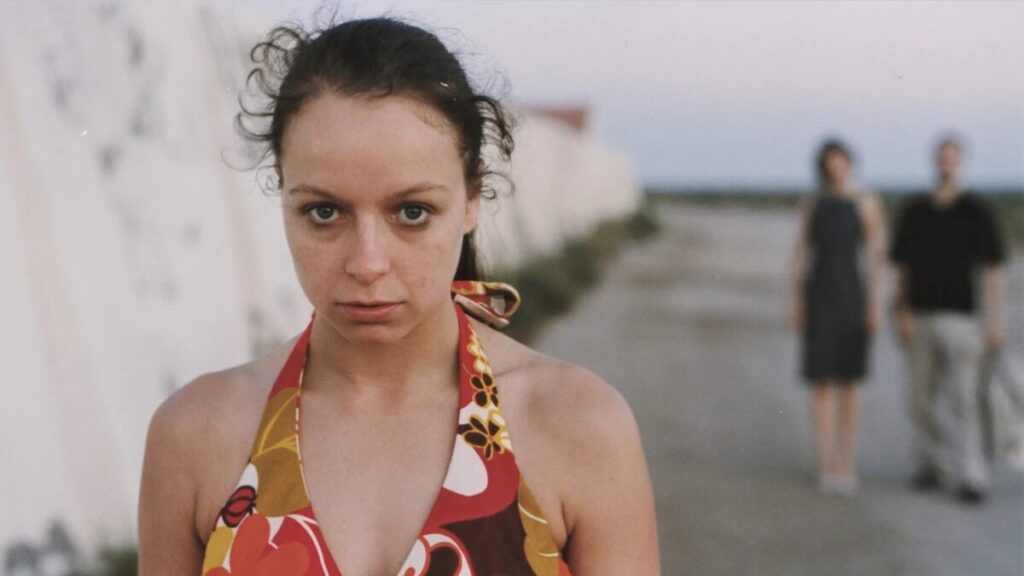
Halfway through Morvern Callar there’s another dramatic location shift. This time from Glasgow (in January!) to sunny Spain, when Morvern and Lanna go on holiday. Initially events follow the standard route of a package holiday involving young Brits. Tons of booze, drugs, loud music, flashing lights, and ill-advised sex. But then, Morvern abruptly tells Lanna that they’re leaving their hotel. And they get taken on a surreal taxi ride by an eccentric and enigmatic figure.
Cinematographer Alwin H. Kuchler begins to use a more bleached-out style, similar to Danny Boyle’s early 2000s work, and this sequence has a dreamlike quality. Morvern and Lanna end up in a deserty area in the middle of nowhere. And even the dead lover’s gifted lighter fails.
After Morvern meets with the publishers interested in “her” novel, she drifts through a cemetery that has tokens left by loved ones. Much like the gifts her lover bequeathed before taking his own life. It’s clear that Morvern loves quiet solitude. Like the moors where she buries her lover, or the deserted areas far from the busy resorts in Spain.
Like with Ramsay’s first feature, Ratcatcher, Morvern Callar is an intimate study, which focuses on the interiority of its central character. The audience is so closely aligned with Morvern, that almost everyone must be rooting for her to succeed at the end. And most viewers probably don’t even view her as a criminal.
By zeroing in on small objects which are significant to Morvern, especially those that she associates with her dead lover, we feel a connection to her, as she connects to them. Ramsay weaves such a delicate thread through the film, and has such a lightness of touch, that this allows Morton’s performance to be the strong anchor at the centre of the story. We never leave Morvern’s side, and we want her to thrive.