


It almost feels like a stereotype at this point. We are made to believe that men who work in industrial industries will be strong, brute and callous. This might not apply directly to real life as often now, but it still does in the movies. There are of course also biases all around the world directed at transgender males as well. In an attempt to explore these ideas, with the addition of love, writer-director Ian de la Rosa crafts a queer love story in their feature-length directorial debut Iván & Hadoum.
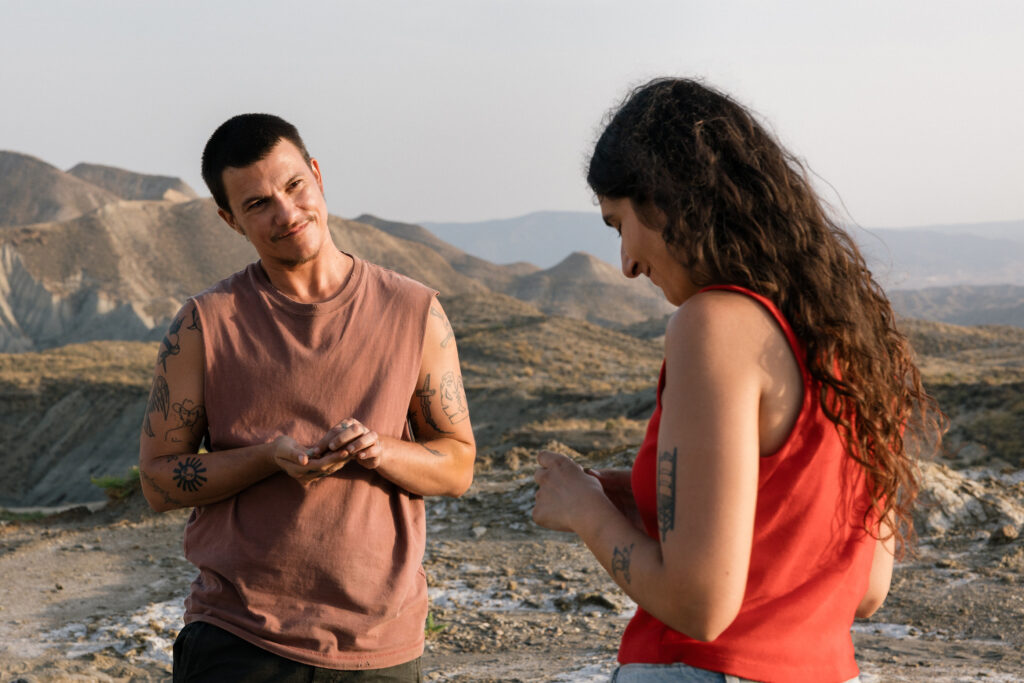
In Southern Spain, two unlikely industrial greenhouse employees fall in love. At age 33, Iván is a transgender man heading towards a promotion in the workplace. While 30-year-old Hadoum works with her female colleagues as simple employees in the greenhouse. On opposing sides, the love they feel for one another gets in the way. Iván is faced with the issue of choosing his long-awaited promotion or his new relationship with Hadoum. As both sides face opposition from family and colleagues, Iván begins to understand that he can be his own man.
With little experience before their feature-length debut, de la Rosa brings a massive amount of knowledge and skill to Iván & Hadoum. The success of the film is the passion that lies underneath the world building and character development in combination with the production. Some films have deep plots that are not thoroughly fleshed out enough to give the audience what it needs to connect. In de la Rosa’s film, however, you can feel the connection they have created between themself and their product.
Iván and Hadoum are not afraid to get right into it. As soon as they lock eyes on each other, this connection appears almost as if out of nowhere. Upon self-reflection as a viewer you begin to understand that connections like this can happen in real life. Knowing someone from your past and having them find you in your present can be ultimately surprising. But what you choose to do with them moving forward is how your life can change for the better.
Iván’s life consists of family and colleagues seemingly being fine with his gender. Yet when he begins developing feelings for Hadoum, that is when their true colours shine. His colleagues warn him not to explore this relationship further and his boss reminds him of what is at stake should he continue. It becomes somewhat of a difficult watch as the two struggle with exterior confrontation and conflict.
The sad fact is that the portrayal of the elements that surround Iván and Hadoum’s relationship feel ultimately mundane in relation to the passion between the two. The struggles they face are nothing compared to how the audience sees them in their intimate space together. Clearly fighting interior struggles, Iván remains torn between the possible outcomes of his future. Yet, in her love for him, Hadoum sees him as the man he could be and hopes he does not conform to society’s standards. With less fear, she urges him to be who he truly is underneath, compassionate and loving. But the audience sees a sense of shame from Iván in his relationship with her. Sticking it out until the end is how his final decision of who he wants to be is revealed.
In a slightly rushed attempt to study societal issues surrounding men and the transgender community, de la Rosa’s feature-length directorial debut is nonetheless filled with empathy and understanding. A personal touch flows through the entire runtime. Chemistry developed between characters and their actors allow for the audience to feel much more. On Friday 13 February 2026 at the 76th Berlin Film Festival, audiences experienced the world premiere of this queer love story. With much more underneath its surface, Iván & Hadoum remains to be tender and emotional wrapped in somewhat of a cautionary tale.