


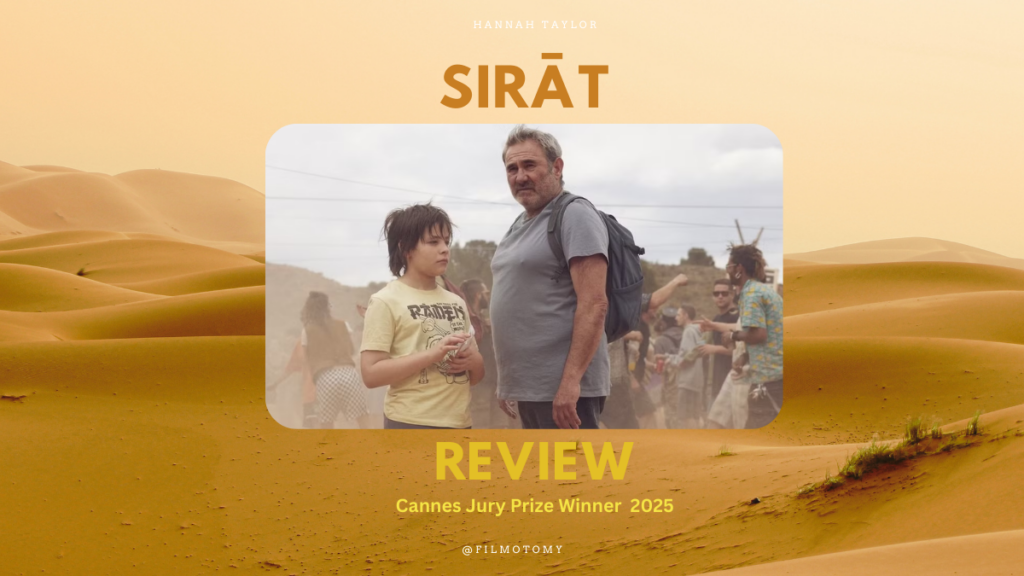
When it comes to reviewing a film like Sirāt (2025) we ask ourselves – ‘where do we start?’ The bizarrely-wired, master in tension, Sirāt leaves you thinking not only how the plot will resolve but where the destination will end. Its title is full of meaning. ‘Sirāt’ translates as ‘path’ with its religious connotations representing a symbol to connect the bridge between Paradise and Hell – often seen as a test of faith. This makes us question if behind Sirāt’s story is a test for the main characters along their journey? The story serves as a clever mirage for spirituality, life, and death.
Sirāt’s director, Óliver Laxe takes a sweeping and slightly mystical direction here. Of course, the film has had a successful festival run, having won the Jury Prize at the Cannes Film Festival, winning five awards at the European Film Awards, and receiving its nomination for Best International Feature Film at this year’s Academy Awards.
Sirāt Review: A Search For a Missing Daughter? Or Something More…
Set in the Moroccan desert, we’re thrown straight into a (heat) rave as clear outsiders to the rest of the ravers – Luis, played by Sergi López, whose acting credits include Pan’s Labyrinth (2006) along with his son Esteban (Bruno Núñez Arjona) and their dog, Pipa rock up to the party scene. Luis and Esteban are desperately searching for daughter and sister, Mar who was last seen at one of these raves a few months prior.
But amongst the reverberation of the monotonous booming comes the army – ready to break up the illegal rave. This comes after an emergency announcement of some new war, which lingers in the background throughout this story. After following some of the ravers off-track, Luis escapes and forges a different path in hopes of finding his daughter.
This group form differing approaches – some show a little sympathy, and others just want to feel the excitement of another rave. We meet Jade (Jade Oukid), Bigui (Richard Bellamy), Josh (Joshua Liam Henderson), Steff (Stefania Gadda), and Tonin (Tonin Janvier) alongside his dog. And together, along with Luis and Esteban, they build a sense of family and belonging. This in turn makes the journey feel a little less lonely for Luis.


Sirāt Review: A Quirky, Spiritual Spanish Thriller
Produced by Spanish filmmaking powerhouse, Pedro Almodóvar, there’s a weird, quirky yet humorous undertone to Sirāt, just like Almodóvar’s own filmmaking style. There’s plenty of tonal shifts throughout that leads us to feeling everything from thrill and adventure to despair and desperation. We’re left reeling in the opaque madness within the isolating desert wilderness with this quirky, spiritual Spanish thriller.
Although Luis and Esteban have a clear goal, it’s questionable what the rest of the group want to achieve other than to experience the thrill of the next rave. Are their goals to become more spiritually connected or perhaps to escape imminent fear of societal collapse and the impending doom of apocalypse? There’s certainly some background irony running as a connecting loop throughout their stories.
But each of their purposes may be intentionally vague to make us question their own morals, goals, and character. After all, they’re living carefree and outsiders to society. Interestingly, other than Sergi López, Laxe chose untrained actors to play the group of ravers. This ultimately gave a sense of closeness to the story and gives a raw and openness to each of their characters as to give the feeling that we are no longer watching a film but a real-life situation.
Sirāt Review: Use of Sound Design to Tell its Story
Sirāt cleverly uses sound to tell its story. Composed by David Letellier (Kangding Ray), the soundtrack mixes both a techno rave sound with an ambient and spiritual cinematic edge to create the movement between excitement to a faithful journey. Letellier recently won the Cannes Soundtrack Award and earned a Golden Globe nomination for his work on Sirat. His techno rave soundtrack is a character within itself.
The loud sonic boom of the speakers is not only reverberated through the hearts of the characters but through the building of tension. Shot on 16mm film, there’s a sense of closeness between the sound design and visuals as the whirl of the sandstorm hits the graininess of the shots.
There’s stark images that can leave us feeling disheartened, and completely fearful for what awaits the characters in the forthcoming scenes. We truly cannot predict what will happen next and that’s what keeps this film moving forward in thrilling increments. Especially as each step and decisions the characters make come with an ultimate risk – the impending doom of death.


Sirāt Review: Utilizing ‘Setting’ as a Character
The desert is a dangerous place that serves not only a deep presence in Sirāt but creates unsettling drama that longs to upend the characters and creates challenges for each of them throughout their journeys. There’s no doubt the desert serves much more than just a location here; it’s an antagonistic character that makes the characters question their own decisions which are crucial for live-or-die scenarios and their constant placement in near-death experiences.
At first, we are led to believe that the journey will be arduous and dangerous, which is exactly what it is, but it leads to so much more. With Sirāt you must expect the unexpected. It has a bizarre tone which is a mix between developing a serious nature along with a humorous undertone. The characters can’t hide from the danger of the journey but most of the time they are oblivious to what lies ahead which ultimately aligns with its spiritual undertones.
However, the most interesting aspect behind Sirāt is in its building of tension to be released within surprises and a series of hugely unexpected moments of tribulation. At points the story becomes almost unbelievable, and we constantly question what we are watching. Act one begins slow and steady and is a stark contrast to its explosive and tensional second act. Whilst act three returns somewhat to the calmer nature of act one. But does it resolve Luis’ goal?


Sirāt Review: Determination Masks the Danger of the Journey
The story is nowhere near as simple as it may seem on the surface. As tension begins to boil, we realise the characters may just be in over their heads. It’s clear that Luis will go as far as his mind takes him on this journey to finding his daughter. Nothing will stop him trying and his determination masks the danger of the journey.
The characters are overwhelmingly well-cast, and we soon gage their familial bonds as we become a part of their clan too. Although Sirāt does not allow you to forget the dangers faced along the way with sweeping sandstorms and ferocious heat serving as a reminder if this arduous journey is truly worth it’s cause. But the characters have come too far in their journey to turn back now.
There’s two goals in this journey – Luis is faced with trying to find his daughter whilst the rest of the characters keep moving to find their next perfect spot to rave in the busking heat. Luis almost works his way towards the top. At first, they see him as a down-and-out father who is attempting to discover the impossible – finding his daughter in the middle of the desert and then they learn to respect his cause as he begins to fit in more with the group. There’s themes of belonging, strength, spirituality, and nature.


Sirāt Review: Highlighting the Harsh Nature of Our World
Sirāt is weirdly engaging as we try to understand it’s purpose. But it’s open to many interpretations. At times, it’s almost too-real and highlights the harsh nature of our world, particularly as the looming chance of war speaks to relevant and current events. Other times it leaves us with an everlasting hope that present situations can become much better if we just try. But its real message lies in the process of the journey, not the end destination and thus the plot is left open-ended to our interpretations.


Ultimately, Sirāt leaves you with quite a solemn aftertaste that lingers long after the final credits roll. It encourages you to think, question, and react to everything that it provides you. In its sparky tone, weirdly bizarre pacing, and quirky story – Óliver Laxe creates a memorable film that places you with an overwhelming feeling of intentional discontent.
One thing’s for sure, expect explosive shocks along the way…
Sirāt is released in UK cinemas on 27th February 2026. You can read our other reviews like Eva Victor’s Sorry, Baby (2025) here.