


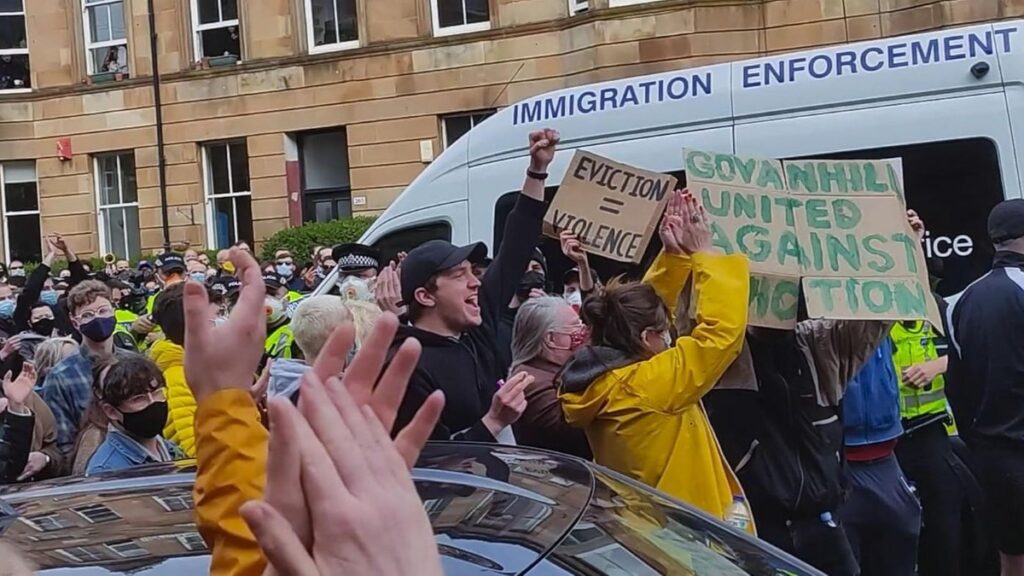
On May 13, 2021, immigration enforcement officers detained two men in the Pollokshields neighbourhood of Glasgow, Scotland’s largest city, in an early morning “dawn raid”. Within hours, a crowd gathered around (and under) the Home Office van where they were held. Residents linked arms, sang, and stood their ground. For eight hours, the van was stuck.
Finally, after increased pressure from peaceful protestors and politicians, the men were released by the Home Office to cheers that resonated across the world on social media. This spontaneous act of community resistance is the focus of Everybody to Kenmure Street, Felipe Bustos Sierra’s powerful documentary, that premiered at the 2026 Sundance Film Festival in the US Documentary Competition.
If you were online that day, you might remember the images: a dense crowd surrounding a white van, chants of ‘these are our neighbours,’ and the surreal calm of a typical Glasgow street turned into a site of civil disobedience for approximately eight hours. Bustos Sierra’s film does more than recount the events. It paints a vivid picture of solidarity in action. His method combines journalism with a deep sense of humanity as he layers dozens of perspectives via “talking head” interviews and found footage.
The volume of material is astonishing, although not surprising. Bustos Sierra collected a remarkable array of phone videos, news clips, and personal testimonies. This rich archive spans decades, including black-and-white footage of Scotland’s social movements – rent strikes, union rallies, anti-racist marches – to show that what happened on Kenmure Street was not an isolated event but a moment rooted in Glasgow’s history. There were surely hundreds of hours of footage that didn’t make the final cut.
Among the voices and spectators are notable figures like Eileen Reid, daughter of the late Jimmy Reid, who played a key role in the Glasgow rent strikes. Aamer Anwar, the Scottish human rights lawyer who has long challenged the Home Office. Journalists, students, workers, activists, and even the two men released from the Home Office van. Their presence connects the documentary to Glasgow’s history of defiance. One single event captured an oral history of resistance in this city.
One question from the Q&A after the screening answered my own thought: what about the police, the council, the government? Bustos Sierra did not include police body cam footage, CCTV security footage, or interviews with those from “the other side”, so viewers would be forgiven for wondering if the perspective was too biased. The director stated that he asked, but no one was responsive. He was satisfied making the documentary solely from the community’s viewpoint. In my view, sometimes silence speaks louder than a voice.
Bustos Sierra’s direction is impressively assured, given the complexity of the subject. Given the restrictions of working with mostly community-captured footage, it never feels like he’s missing a shot or the pacing is off. The voices of those interviewed after the fact speak out over the footage, giving context and moving the film along. Wherever possible, he includes moments of lightheartedness and community spirit: the bus station tuck shop becomes an impromptu gathering place for activists and onlookers. This detail helps anchor the film in a distinct place, making it undeniably Scottish.
There are some parts of Everybody to Kenmure Street that allow Bustos Sierra to use his creativity. As well as archival footage, found footage, and talking heads, he uses dramatic recreations to ensure key players in the protest aren’t left out. Emma Thompson (yes, that Emma Thompson) steps in as The Van Man, the brave soul who wedged himself under the Home Office van and, without whom, the protest wouldn’t have happened. Kate Dickie steps in as the nurse who provided aid to The Van Man. They give voices to the words of those who can’t legally offer their own, making for a well-rounded and more visually interesting documentary.
The historical context is also crucial here. Bustos Sierra connects various eras so effortlessly. The Glasgow Girls of Drumchapel School, known for campaigning against deportations in the 2000s, appear alongside footage of 1970s shipyard protests, linking industrial solidarity to current anti-racist actions. The result is a portrayal of a city that has consistently stood up against Westminster. A place that feels very far away both geographically and ideologically.
Bustos Sierra himself is no stranger to activism. He was born in Chile and partly raised in Belgium after his journalist father’s exile following the 1973 coup d’état. There, he attended Chile solidarity meetings and learned about the Scottish Rolls-Royce plant workers in East Kilbride, who boycotted servicing the country’s fighter jets after the military coup. Thus, Bustos Sierra made his first feature documentary, Nae Pasaran (2018). During the Sundance Q&A, he stated that he lives close to Kenmure Street in Govenhill, but learned about the protest too late. He expressed the regret at missing out on the “collective joy” was something that motivated him to make the documentary.
Watching from Utah through the Sundance online platform, I couldn’t help but feel prideful of my home nation. Despite the inconvenience of the spontaneous protest, hundreds flocked to Kenmure Street and the outcome was peaceful and positive.
Many American media outlets are asking the same question: can what happened in Everybody to Kenmure Street happen in the fight against ICE? This movie wants to inspire and demands communities to apply the lessons demonstrated in the footage. But, as we know, what happened on May 13, 2021 was an anomaly. Several factors had to align to achieve the outcome of Everybody to Kenmure Street where the two men detained were released. It required a friendly community, lawyers on hand to mediate, politicians and a public willing to advocate and, crucially, law enforcement who de-escalate rather than confront.
But that doesn’t mean the public shouldn’t try . If anything, Bustos Sierra’s documentary suggests the opposite. Change is rarely neat or easy to replicate. But if a small community can come together to fight injustice against two men, the ripple effect may inspire others to help many more in the future.